
23
interface languages
The owner reads Chinese. The server was hired locally and reads Spanish, Vietnamese or Khmer. The guest reads something else again, and the tax office wants the receipt its own way. MiYaDine treats that as the ordinary case rather than an edge case — and keeps taking orders when the connection drops.
A restaurant product from a company that has been making software for shops run overseas since 2007. MiYaDine itself launched in 2024 and is now at V3.0.
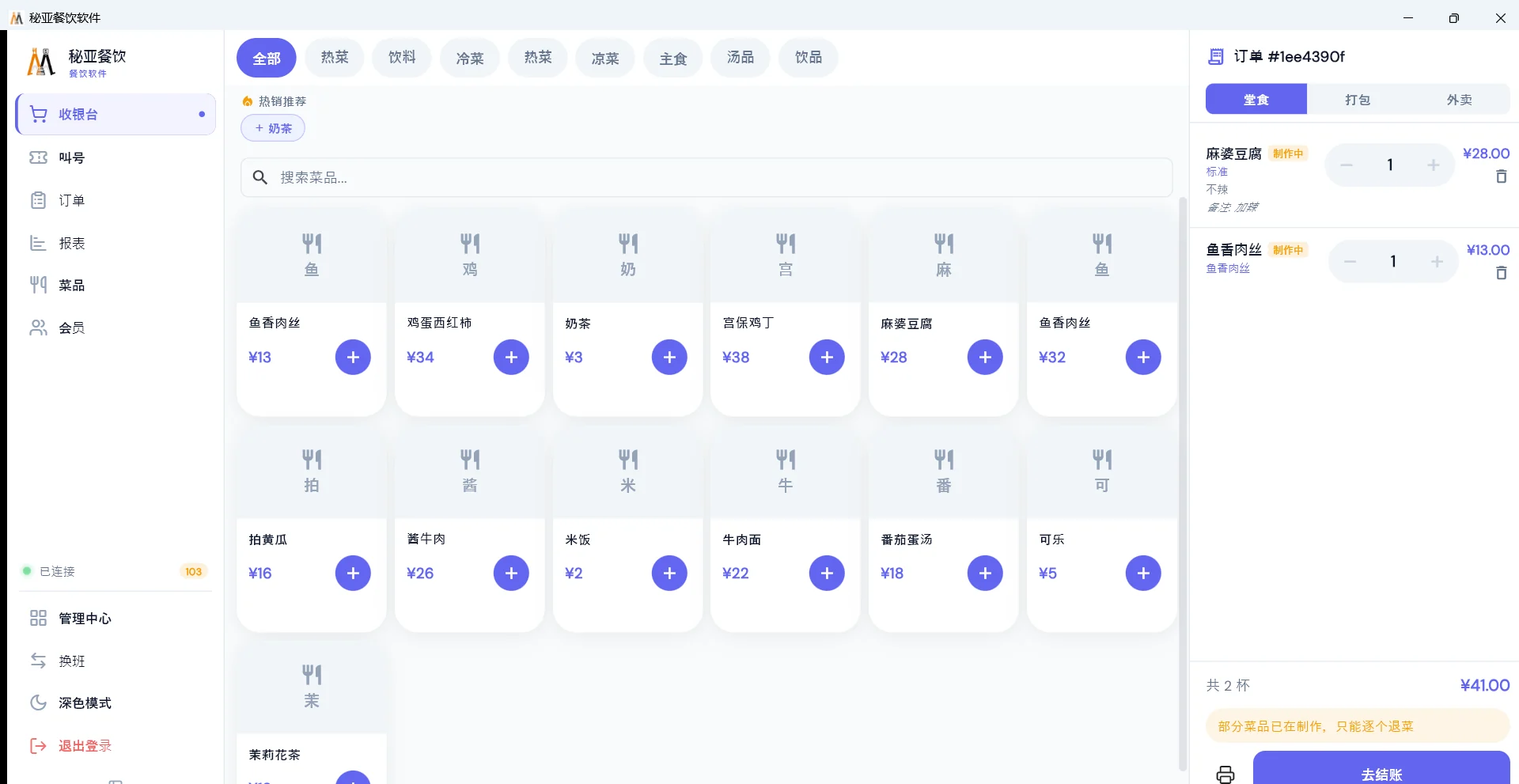
MiYaDine is the restaurant point-of-sale and ordering system built by Guangzhou Miao Software Technology Co., Ltd. (MISAll) for restaurants run overseas, launched in 2024 and now at V3.0. It runs the front counter, the table map, QR self-ordering, the kitchen display and the member programme in 23 languages, settles in 20+ major currencies under local tax rules, keeps taking orders when the internet drops, and lets an owner in another country watch the shop remotely. It covers 9 restaurant formats and is in use across 100+ countries and territories.
It is one system rather than a suite. The till, the floor map, guest self-ordering, the kitchen screens, the member records and the reports all read the same catalogue — which is why changing a price is one edit and why a dish sold out at 20:00 disappears from the guest's phone as well as from the counter. Our sister product MISAll does the same job for supermarkets and retail; this site is only about restaurants.
Three requirements a system designed for a domestic market usually does not have — and the reason importing one tends to fail in the second month.
23 languages ship with the system, and the choice belongs to the account rather than the installation. Two terminals in the same room can run in different languages at once — you read margins in Chinese on the office machine while the counter stays in the local language all day, off the same dish record. How it works →
Single-machine and LAN modes need no internet. Orders, kitchen tickets, QR self-ordering on the shop's own wifi and checkout all carry on through an outage, and sync when the line returns. Within the shop, stock is deducted on the host machine so two tills cannot oversell the last bottle. What happens offline →
Revenue, tables, dish rankings and members from a browser — plus real actions: mark a dish sold out, disable a staff account, push a menu change down to a store. Each store keeps its own currency, tax setup, time zone and trading day, so a 2am bill lands on the right day. Remote oversight →
Table map, open / merge / transfer, split bills, service charge by area, mixed payments and shift cash-up.
Guests scan the code on the table and order from their own phone — no app, no sign-up, works on the shop LAN.
Tickets routed to the right station, ageing orders change colour, tick off when the dish is plated.
One dish record, two names. The owner reads Chinese, the staff and guests read the local language.
Three channels, one production queue, one set of books — plus pickup numbers for counter service.
Top-up balances, tiers, birthday campaigns and vouchers redeemed at the till.
A hotpot restaurant and a bubble tea counter need almost opposite interfaces — one runs a floor map and seating timers, the other runs pickup numbers and never sees a table. Choose the format when the store is set up; change direction later and it is a setting, not a migration and not a second purchase.
See all nine →NRS. The Federal Inland Revenue Service became the Nigeria Revenue Service on 1 January 2026 under the Nigeria Revenue Service (Establishment) Act 2025. It is the same institution with a new name, so older FIRS guidance is usually still accurate on substance.
No, and treating them as one file is the mistake. The sales-recording obligation is tax law administered by Revenu Québec. The French obligation is the Charter of the French Language, administered by the Office québécois de la langue française. You can satisfy one inspector and fail the other on the same printed bill.
Nothing, if the till and the router are on battery and the data lives locally. The hard part is the hour afterwards, when the slips written by hand have to become records that satisfy SARS. Plan the recovery, not just the outage.
It depends entirely on your annual turnover. Below RM1 million you are outside the mandate; between RM1 million and RM5 million you have been in scope since 1 January 2026 but penalty-free until 31 December 2027. Everything above RM5 million is already live and enforced.
On the facts as described, the customer has a point. The ACCC position is that a restaurant applying a surcharge on particular days must say so on the menu, in words at least as prominent as the most prominent price. If that statement is missing, the surcharge was not properly disclosed before the guest ordered.
For dine-in guests you issue a simplified tax invoice, and it must carry five things - the words Tax Invoice, your name, address and TRN, the date of issue, a description of what was supplied, and the total consideration with the tax amount charged. VAT is 5% and the authority is the FTA, not ZATCA.
There is an AI assistant inside the software answering operating questions from a knowledge base that ships with each version, and a full illustrated manual. Behind those is a human team on WeChat: 08:00–23:00 China Standard Time (UTC+8) — 00:00–15:00 UTC, seven days a week. 24/7 response for critical incidents.
Worth stating plainly: that human team works in Chinese, and so does the manual. The software runs in 23 languages; the person on the other end of the message does not. For a shop where the owner is the one who contacts support — which is most of the shops we serve — that is usually the right trade, but you should know it before you buy rather than after.
Four other sites from the same company, each covering a different part of trading overseas. If your question is not about restaurants, one of these is the better place to start.
Fiscal devices, local payment channels and delivery platform integrations differ sharply by country. Tell us where the shop is and we will give you a straight yes or no for your market.